
Guide to Vermont Divorce Records
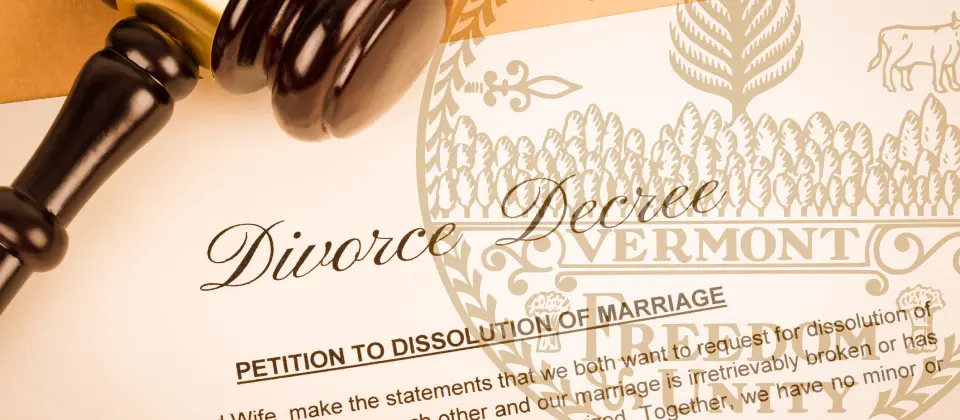
Divorce regulations as well as documentation requirements can differ depending on the state you live in, and Vermont is no exception. Therefore, it is important to understand how a divorce is handled in Vermont if you are going through a divorce yourself or want to obtain copies of your divorce records.
When one spouse petitions for divorce in the Family Division of the Superior Court in Vermont, the court generates various official documents during that process. Together, these documents constitute the divorce record and serve legal and administrative functions.
The amount of detail that is included in the Vermont divorce record will vary depending on the type of divorce records you are requesting.
A typical Vermont divorce record would contain some or all of the following information.
Names of both parties involved in the divorce
The county in which the divorce case was filed
The name of the court that handled this case
The date when the divorce was completed
The docket number for the court case
Any terms pertaining to custody, visitation, and parental rights
Type of judgment (contested or uncontested)
In Vermont, most divorce records are maintained by the Family Division of the Superior Court on a county basis. However, summary records can be found through various state agencies.
Physical copies of older divorce records (paper files or archives) are typically kept for divorces finalized before the automated digital recording system was implemented. The newer divorce records are being housed electronically; however, the public may have limited or no access to all parts of the case documents and may need to submit a formal request to obtain them from the appropriate court.
Knowledge of the Vermont divorce process may help you better understand how your divorce record is generated. Additionally, knowing the types of divorce documents and what they typically include will help you access the right document for legal and administrative purposes.
Where Are Vermont Divorce Records Stored?

At the county level, divorce records in Vermont are kept with the Family Division of the Superior Court in the county where the divorce was filed and finalized. You can find your official case file here, which includes the complete divorce decree, motions, and all documents used to support your divorce proceedings.
At the state level, Vermont's Division of Health, Vital Records Section, is responsible for maintaining an index of all divorces in the state and for providing certificates of divorce as proof of dissolution of marriage. However, the health division retains these certificates only for the most recent 5 years for reporting and record-keeping purposes; after those 5 years have passed, the department will destroy them.
If you need to find information on a divorce that is older than five years, you must contact either the Vermont State Archives and Records Administration (VSARA) or the Superior Court in the county where the divorce was granted. VSARA and the courts preserve historical divorce records, such as older divorce certificates and complete decrees; therefore, both agencies can provide an individual with copies of their historic divorce documents.
Is Vermont a 50/50 Divorce State?
Unlike states that use an automatic 50/50 split of all marital assets (community property states), Vermont has a much more flexible approach to dividing marital assets. Vermont uses an “equitable distribution” system. This means that when you go through your divorce, the judge will decide how to fairly divide the marital assets according to the specifics of your situation.
Vermont Statute Title 15 § 751 governs how marital property will be distributed in divorce cases. According to this statute, the courts are required to distribute the property “equitably” (meaning fairly) among the divorcing spouses. In contrast, in “community property states,” marital assets are typically split equally between the divorcing spouses, with each spouse entitled to fifty percent (50%) of the total marital assets by default.
Several factors influence how marital assets are split in Vermont, including:
Length of the Marriage: Courts in Vermont are more likely to divide marital property more fairly in longer-term marriages. Conversely, courts tend to revert to a previous economic status for spouses in shorter marriages.
Contributions of Each Spouse: Vermont courts consider both the financial and non-monetary contributions of each spouse.
Income and Earning Capacity: The Vermont courts will consider each spouse's current income and future earning capacity.
Marital vs. Separate Property: All property obtained during the marriage is considered marital property. Separate property includes money received as an inheritance or money given as a gift prior to the date of separation. Generally, marital assets will be divided between the two spouses, but the court does not have authority to award separate property unless that asset has become commingled with marital assets.
Fault Consideration: Although Vermont is a “no-fault” divorce state, its courts will consider certain factors regarding the parties' respective merits. Therefore, if one spouse engaged in marital misconduct, such as infidelity or other conduct that adversely affected the couple's financial stability, the court will consider these circumstances when dividing the marital assets.
Types of Vermont Divorce Records

Divorce documents in Vermont differ from one another. For example, some divorce documents can provide quick proof of a divorce, while others contain a detailed, enforceable court order that defines and explains the rights and responsibilities of both parties after the divorce.
Vermont Divorce Certificate (Certificate of Divorce)
A Vermont divorce certificate, also known as a Certificate of Divorce, is a summary document issued by the Vermont Department of Health. Generally, these can only be obtained for divorces that occurred within the last 5 years, as this department retains them primarily for data and administrative purposes. Divorce certificates older than five years are typically kept by the court that heard the case.
The Divorce Certificate contains very limited information, usually the names of both parties, the date the divorce became final, and the name of the court where the divorce hearing took place. Due to its limited scope, it is often used for various ID-related activities, such as updating government agency records, qualifying for government benefits, and providing proof of eligibility to remarry.
A divorce certificate is not a replacement for a complete divorce decree, as it excludes any of the specific language contained within the decree. Consequently, a divorce certificate cannot be used to enforce or define the specifics of any agreements made in the divorce.
Divorce Decree (Final Judgment of Divorce)
The divorce decree, also called the Final Divorce Decree, is the most authoritative and legally binding document issued by the Vermont Superior Court. This document constitutes the formal termination of the parties' divorce case and includes the court's complete rulings on every aspect of the dissolution of their marriage.
Final judgment of divorce in Vermont will usually contain all the following rulings:
Property and Debt Division: The divorce decree states how marital property (assets & debts) is to be divided between the parties.
Alimony: if it is ordered by the court, the decree shall specify the type, amount, and duration of spousal support.
Child Custody and Support: Describes the arrangement for each child's legal and physical custody and the type of support intended.
Final Judgment Date: The official date that the judge signs the decree, which marks the date on which the termination of the marriage was granted.
Since divorce decrees establish and outline specific legally binding obligations, they are used when it is necessary to prove or enforce an individual's rights, such as modifying existing custody agreements, collecting child or spousal support, or resolving disputes over property distribution.
How to File for Divorce in Vermont (Step-by-Step)
Before a couple can seek divorce in Vermont, they must meet the state's residency requirements. The Vermont Code (15 V.S.A. § 592) states that before filing for divorce, at least one party involved in the divorce proceeding must have established residency in Vermont for a period of no less than six months. Additionally, the divorce cannot be finalized until both parties have been residents of Vermont for at least twelve months.
Once residency has been established, the next step in the divorce process is to determine which type of divorce to file for. The type of divorce, uncontested or contested, affects how long it takes, how much money is needed, and how complicated the overall process is.
Uncontested Divorce: An uncontested divorce occurs when both spouses agree on all issues before filing for divorce. Examples include agreeing on how to divide assets and debts, how children will be cared for and supported, and any spousal support agreements.
Since neither spouse intends to dispute anything with the other, the process is usually much faster, simpler, and cheaper than an average contested divorce. The court's primary function in an uncontested divorce case is to verify that the agreed-upon terms comply with the law and then enter a final judgment.
Contested Divorce: A contested divorce is a divorce in which spouses cannot agree on certain aspects, including the division of property and child custody. At this point, the couple has reached an impasse that requires a judge to intervene and render decisions for them. Therefore, there will generally be more steps involved in the legal process. These extra steps will include discovery (exchanging financial information and other relevant data), negotiations, and, if necessary, a trial.
Step-by-Step Divorce Process
The divorce process may vary across Vermont, but generally follows these steps outlined below:
Prepare the Filing Packet
This stage requires you to prepare all the documents needed to file for your divorce.
Identify the Divorce Path (1A vs. 1B): Determine whether the divorce is uncontested or contested.
Typical Documents: The following forms are commonly required when preparing a divorce filing packet in Vermont:
Information Sheet (Form 800): This form provides the court with general guidance on how to start and maintain your divorce file, including details such as the parties' names, contact information, and the type of case.
Complaint for Divorce/Legal Separation With Children: This form initiates the divorce case and outlines the parties' information, the reasons for divorce, and the proposed child custody arrangement.
Statement of Confidential Information (Form 400-00849): This form allows you to safely submit private identification information, i.e., Social Security numbers, bank accounts, etc., outside of the public records.
Department of Health Record of Divorce or Annulment (Form VDH-VR-DIV): After the divorce is finalized, this information sheet is sent to the Vermont Department of Health, so they can update their records.
Notice of Appearance of Self-Represented Party (Form 400-00831): If one of the parties represents themselves in the case, they file this form to notify the court and the opposing party that they intend to represent themselves in the case.
You can find these forms on the Vermont Judiciary Divorce Process webpage.
Other documents to include with the application form include your marriage license, inventory of assets and debts, pay stubs, tax returns, and documents supporting custody and support claims.
Filing Fees and Fee Waivers (Indigency): To file for divorce in Vermont, you must pay the court filing fee. The cost of filing fees can vary from one county to another. However, the typical range for filing fees is $90-$295, depending on whether the divorce is being contested or uncontested.
If you are unable to afford filing fees, then you have the option to petition the court for a waiver of filing fees based upon indigence by completing the Application to Waive Filing Fees and Service Costs form. Once filed, the form petitions the court to waive filing fees as a result of your current financial status.
File the Case
The next step after you have completed your paperwork is to file the documents at the appropriate court.
Where to File: In Vermont, divorce cases are filed with the Family Division of the Superior Court, specifically the Vermont Superior Court in the county where either spouse resides.
Filing Methods: The Vermont Judiciary provides three different options to file your documents. These methods are as follows:
In Person: You can file your paperwork yourself or have someone else do it on your behalf in person at the Clerk's Office in one of the three locations listed above. The Clerk's Office will review and file your paperwork. Additionally, you can place the paperwork into a Drop Box located at the entrance of each courthouse.
Mail: If filing by mail, send an envelope to the correct division of the court. Include a check or money order for the filing fees or the fee waiver application. Mail service time will vary.
Email: Vermont allows divorce filings to be submitted electronically by emailing scanned copies of your paperwork in PDF format to the court, following their directions.
What You Receive: Once your divorce petition has been accepted for processing with the courts, you'll receive documents that begin your divorce proceeding, including:
Case Number: A unique identifier that serves as a way for the courts to track your divorce through their processes.
Summons (if the parties are contesting): This is an official court notice informing the opposing party that divorce proceedings have begun.
Initial Court Notices: These may provide information on procedures and scheduling for your case.
Service of Process (Primarily for Contested Cases)
Service of Process is arguably the most important procedural step after filing a Divorce Case in Vermont, especially when there are issues with the divorce process. When a spouse files for divorce in Vermont, the filing spouse (plaintiff) must serve the other spouse (defendant) with the divorce papers. The plaintiff can use any of the following authorized methods:
Sheriff's Department
Professional process server
Certified mail
It is crucial that you provide evidence that you have properly served the divorce paperwork, as failure to do so could prevent the court from proceeding with your case.
Vermont Law provides for alternative service procedures if the plaintiff has used good-faith, reasonable efforts to locate the defendant and has failed. However, for the plaintiff to use alternative service procedures, the court will require documentation demonstrating due diligence in locating the defendant. If these efforts fail, the court may allow Service by Publication, in which the filing spouse must publish a notice of the divorce in a newspaper or by another acceptable means.
Early Case Phase and Temporary Orders
During the initial phase of the divorce process, the judge's focus will be to establish short-term arrangements for the couple while the divorce is still being litigated. Since a final judgment can take months or even years to reach, especially in highly contested divorces, the judge may enter Temporary Orders to provide stability to both parties and reduce potential conflict or disruption to each other and their families.
One of the main goals during this initial phase is to maintain the “status quo” or current arrangements. For example, if parents have been co-parenting and sharing responsibilities, they continue to do so, and if one spouse has historically paid bills, that continues. The purpose of this approach is not to finalize decisions regarding how the parties' lives will be divided. Instead, its purpose is to provide both parties with fair treatment, consistent rules, and minimal disruptions to their daily routines.
Some temporary orders issued by the Vermont Courts include:
Temporary Custody and Visitation: The court will usually make some immediate decisions regarding the arrangement for temporary custody and visitation.
Temporary Child and Spousal Support: Likewise, the court can order one spouse to pay temporary financial support to the other during the early phase of the divorce case.
Exclusive use of the Marital Residence: In some cases, the court may also decide that one spouse is entitled to exclusive use of the marital residence until the divorce proceedings are resolved.
Restraining or Protective Orders: If there is an immediate concern for safety, harassment, or abuse, the court can enter a restraining or protective order.
Financial Disclosures and Discovery
As a Vermont divorce case progresses, both spouses are required to share their personal finances. This is called the financial disclosure and discovery phase. Both spouses are expected to provide all relevant, true, and complete financial information.
Elements of financial disclosures in Vermont divorce cases include:
Mandatory Disclosure: Both spouses are generally expected to complete a sworn affidavit outlining their financial status, including income, expenses, assets, and debts. Typically, these forms outline the types of assets or property they own, such as checking or savings accounts, property, retirement plans, or investments, as well as the types of liabilities they owe, including mortgages and credit cards.
Discovery Tools: Formal discovery tools may be used by each party in a contested divorce case to gather additional information and verify the accuracy of the opposing party's disclosures. Formal discovery is particularly useful in situations involving suspected hidden assets, disputes over income or financial reporting, and similar matters.
Requests for Documents: Provide one spouse with the opportunity to request the production of relevant financial documentation from the other spouse. The requested documents could include prior year's tax returns, recent pay stubs, recent bank statements, and the current summary report of their retirement accounts.
Written Interrogatories: Written inquiries that require the responding spouse to respond in writing. Each response should be sworn to.
Subpoena: It is issued to obtain information from an entity, such as a bank or employer, that maintains records related to the marital estate.
Depositions: In-person examinations of witnesses (typically in a lawyer's office, although they can occur anywhere), taken under oath, and recorded for future reference.
Case Management and Court Conferences
In many Vermont divorces, the very first court hearing is usually a case management conference. A typical case management conference in Vermont isn't presided over by a judge; rather, it's led by a case manager with whom both spouses work. The objective of a case management conference is to determine which issues each spouse can agree on, as well as the number of other matters that a judge or magistrate will have to decide for them.
The role of the case manager at a case management conference is generally to help guide discussions about what needs to occur and to maintain focus on the matter at hand. When minor children are involved, specific topics regarding parental responsibilities, custody, and financial obligations, visitation and time with their parents, child support, will also be discussed.
The court may schedule a Pre-Trial Conference at any time prior to trial. This is distinct from the Case Management Conference in that it will be held by a judge. At this meeting, the court will review the status of the case, determine which remaining issues require resolution, and discuss the potential for settlement.
The judge can also direct both sides on the procedures to be followed, set or suggest specific deadlines for these procedures, and ensure that both sides are prepared to present all relevant evidence should the case proceed to trial.
By the time cases get to these conferences, the courts expect:
Both parties are ready for discussions,
That they are willing to work together
Both parties make an honest attempt to settle as many of the remaining disputes
Parties to explicitly list out what still remains at issue
Settlement or Trial
Settlements occur when couples agree on most of the issues they need to finalize their divorce, such as property division and child custody. The couple's agreements are written down and filed with the Vermont Superior Court. Once approved by the court, those agreements are incorporated into the final judgment.
Couples can reach an agreement through:
Direct negotiations with each other
Mediated agreements
Negotiations facilitated by their attorneys
When a couple cannot agree on all issues related to their divorce, and there are substantial areas of disagreement, the matter goes to trial. At trial, the Superior Court judge serves as the decision-maker, resolving all disputed issues based on the evidence presented at the hearing.
At trial, you should expect:
Both sides will present evidence and call witnesses to support their respective positions.
Each party will submit proposals for the court's acceptance as Findings and Judgments.
The Superior Court judge makes decisions on all unresolved issues and enters a binding Final Judgment and Decree that completes the dissolution of the marriage.
Judgment, Waiting Periods, and Finalization
Pursuant to Vermont Statutes Title 15 § 554, Vermont law requires a 90-day waiting period after the court has made its final determination (final hearing) prior to when the divorce will become “effective” or “absolute.” Although the divorce has been finalized by the court, neither party may remarry until the end of the 90-day period.
Child Custody and Child Support in Vermont Divorces
In Vermont, when children are involved in a divorce proceeding, the court's first concern is ensuring that every decision supports the children's overall well-being. Vermont courts determine custody based on the “best interest of the child,” as defined in Vermont Statutes Title 15, Section 665.
To determine what is best for the child, the court reviews several factors:
The child's relationship with each parent
Each parent's ability to provide care and stability for the child
The child's adjustments to home and school
Each parent's participation in the child's daily routine
The age of the child and their needs
The child's preference (depending on the child's age and maturity)
Legal Custody vs. Physical Custody
Vermont divides parental rights into two categories: Legal Custody and Physical Custody. Both aspects of a child's custodial situation need to be resolved if there are children involved in a divorce.
Legal custody means that one or both parents have the authority to make important decisions regarding the child, such as education, health care, and overall well-being. Typically, this decision-making power is split equally between parents unless circumstances prevent an equal division of responsibility.
Physical custody, however, refers to which parent the minor child resides with on an ongoing, daily basis and the arrangements for allocating parenting time. A court can award one parent full-time physical custody of a child, or both parents can have structured visitation schedules.
Child Support Guidelines and Enforcement
Child support in Vermont is computed using guidelines as set forth in Vermont Statutes Title 15, Section 654. This child support calculation includes the following factors:
Income of both parties
Health insurance expense
Number of minor children
Time spent by each party with each minor child
Any other costs associated with the minor children
Once an obligation of child support has been established through court action, it is considered legally binding. Failure to comply with child support obligations will result in enforcement measures, including:
Court enforcement that could result in incarceration or fines
Interception of your federal and state income taxes
Suspension of a driver's license or professional license
Wage garnishment
Property, Debt, and Alimony in Vermont Divorces
When couples get divorced in Vermont, the court must decide on several important financial issues, including how property will be split, who owes which debts, and what type of support may be awarded.
In Vermont, there's a distinction between marital and separate property.
Marital property is any asset that was acquired together by both parties during the marriage. That could include income earned while married, houses purchased with marital funds, retirement accounts, and joint bank accounts funded with marital funds.
Separate property is any property that one party owned prior to getting married or inherited after marrying, or was gifted. In Vermont, the courts attempt to respect separate property, but will still divide it if it has become commingled with marital assets.
Just as assets are divided between spouses, so too must debts be allocated between them. Marital debt includes mortgage payments, credit card balances, auto loans, and other obligations that either spouse may owe.
As with property division in Vermont, the court divides the couple's debt based on what is fair and equitable, rather than an automatic 50/50% split. In determining how each party should pay its portion of their joint debt, the court will take into consideration:
Who incurred the debt?
For what did they incur this debt?
Can either or both of the parties afford to pay back this debt?
How was one spouse able to benefit from this debt?
What is the final distribution of the couple's marital property?
Alimony, also known as spousal maintenance, can be granted to help a spouse meet their financial needs after divorce. There are three primary types of alimony that are recognized in Vermont.
Temporary Alimony: Temporary alimony is an amount paid during the divorce process to support one spouse while they await finalization of their divorce.
Rehabilitative Alimony: Rehabilitative alimony assists one spouse in becoming self-sustaining, typically by providing sufficient time to pursue education, training, or employment.
Permanent or Long-Term Alimony: The court may grant rehabilitative alimony in situations such as a lengthy marriage, or when it appears there is no way for one spouse to become completely independent.
Errors, Omissions, and Corrections in Vermont Divorce Records
Errors or omissions on divorce records are typically caused by a clerk's error, lack of complete information provided on the documents submitted to the court, or inaccuracies in the documents submitted. Common errors in Vermont divorce records include misspellings of individuals' names, incorrect dates, and inaccurate case numbers. Since divorce records are used for various legal, financial, and administrative purposes, errors can cause additional problems when the records are needed in the future.
To amend your Vermont divorce records, contact the Vermont superior court that handled the original divorce. However, depending on whether the error is clerical or substantive, and on how serious it is, the method of correction varies.
Administrative corrections do not always require a formal court hearing. In most instances, these types of correction requests are made through the court clerk's administrative actions by completing relevant forms and supporting the correction with documents containing the correct information.
In cases where the error is substantive, such as child visitation rights, support requirements, or distribution of marital assets, you need to file a motion with the appropriate court to correct the error. The court may require an appearance before a judge to determine whether to approve the modifications to the divorce record.
Once corrections are accepted and added to the court's permanent public records, you may ask for newly certified copies of your divorce documentation.
You can obtain a copy of a divorce certificate by contacting the Vermont Department of Health if the event occurred within the last five years.
You can request a divorce decree and divorce certificates older than five years from the Clerk of the Superior Court in the County where your divorce was granted.
How to Access Vermont Divorce Records
The availability of divorce records in Vermont depends on the kind of record you need, a summary certificate or the entire divorce court decree, as well as the time frame in which the record was created.
Online Access
Divorce Certificate: Recent divorce certificates can be obtained online through the Vermont Department of Health's Vital Records Ordering Service. However, these records will only go back up to the last five years.
Divorce Decree: Full divorce decrees are generally not available online for free, as they often include specific details about the divorce. In most cases, access to them is limited solely through your local court.
In Person
Divorce Certificates: Go to the Vermont Department of Health. They provide certified copies of divorce certificates for divorces that have occurred in the past 5 years.
Divorce Decrees: Go to the Clerk's Office at the Vermont Superior Court in the County where the divorce was finalized. They can issue you a certified copy of the full judgment.
Divorce Certificates: Mail an application or letter to the Vermont Department of Health, along with a completed application form, your identification information, and payment of the search and certification fees.
Divorce Decrees: Mail the request to the Superior Court Clerk in the appropriate county and ask them to send you a certified copy of the divorce record.
Vermont Courthouses That Handle Divorces
Vermont residents should understand which court has jurisdiction over divorce cases and which courts within the county accept and preside over divorce matters.
Court Authority for Vermont Divorce Cases
All Divorce cases in Vermont are processed through the Vermont Superior Court's Family Division. Therefore, the Vermont Superior Court is the only court authorized to hear divorce actions, child custody matters, and all other domestic relations matters in the state.
In contrast to some states, which may have multiple District Courts or Circuit Courts, Vermont utilizes a unified Superior Court System with divisions. The Family Division specifically hears all divorce cases from commencement through conclusion.
County-Based Filing
Although there is a single Unified Court System in Vermont, divorce action filings and subsequent record requests are made at the county level. Therefore, you must initially file your divorce action and subsequently obtain copies of records where either spouse resides or where your original case was heard.
Below are examples of Vermont county courts where you can get divorce records.
Chittenden County: Chittenden County Superior Court (Family Division)
Washington County: Washington County Superior Court (Family Division)
Rutland County: Rutland County Superior Court (Family Division)
Windsor County: Windsor County Superior Court (Family Division)
Franklin County: Franklin County Superior Court (Family Division)
Jurisdiction Basics
In Vermont, a court can only hear and decide a divorce case if it has both subject-matter jurisdiction and personal jurisdiction over the parties. The Family Division is the only division of the superior courts in the state permitted to issue divorce orders and enter final judgments of divorce. Therefore, all other divisions of the superior courts, probate or civil, are prohibited from proceeding with divorce actions.
Examples of Vermont Superior Courts
All of Vermont's 14 counties have a Family Division of the Superior Court that handles divorce cases. Here are some Family Division Courts in the state:
Chittenden County Superior Court (Family Division of the Vermont Superior Court)
Washington County Superior Court (Family Division of the Vermont Superior Court)
Rutland County Superior Court (Family Division of the Vermont Superior Court)
Windsor County Superior Court (Family Division of the Vermont Superior Court)
Franklin County Superior Court (Family Division of the Vermont Superior Court)
Role of the Superior Court Clerk
In divorce cases filed in Vermont, the Superior Court's Clerk has several administrative functions. The Clerk is responsible for:
Receiving and processing divorce filings and legal documents
Issuing a case number for the case and providing maintenance of official case files
Issuing processes such as summonses and notices from the court
Providing certified copies of divorce decrees or other records requested
Helping the public with the procedure, but not the law
Reviewing documents filed with the court to ensure compliance with court filing requirements
FAQ
Are Divorce Records Public in Vermont?
Yes, most divorce records are public under the Vermont Public Records Act. However, certain sensitive information, such as Social Security numbers, financial details, or records involving minors, may be restricted or redacted.
What Is the Difference Between a Certificate and a Decree?
A divorce certificate is an abbreviated summary document primarily used for verification purposes, whereas a divorce decree is a full court judgment that includes complete legal determinations of custody, support, and property division. Therefore, divorce decrees are legally binding documents.
Do I Need to Know the County?
Yes, you will need to know the county where the divorce was filed, as county courts maintain those records. Without the county, finding that decree can take some time or require multiple searches.
How Far Back Do Records Go?
The length of time a divorce decree remains in effect depends on how long the courts retain those records. Divorce certificates are typically maintained by the state for the last five years. Older certificates are retained by the local court where the case was filed.
How Much Does It Cost?
Costs can vary by county. However, certified copies of the divorce record usually cost about $10. Search fees and additional copies can result in extra costs.
Can I Search Vermont Divorce Records for Free?
While there may be limited public access to these documents for free through the courts' online search tool or by viewing them at the courthouse, certified copies of this document cannot be obtained without paying a fee.
Table of Contents
- Where Are Vermont Divorce Records Stored?
- Is Vermont a 50/50 Divorce State?
- Types of Vermont Divorce Records
- How to File for Divorce in Vermont (Step-by-Step)
- Step-by-Step Divorce Process
- Child Custody and Child Support in Vermont Divorces
- Property, Debt, and Alimony in Vermont Divorces
- Errors, Omissions, and Corrections in Vermont Divorce Records
- How to Access Vermont Divorce Records
- Vermont Courthouses That Handle Divorces
- FAQ